
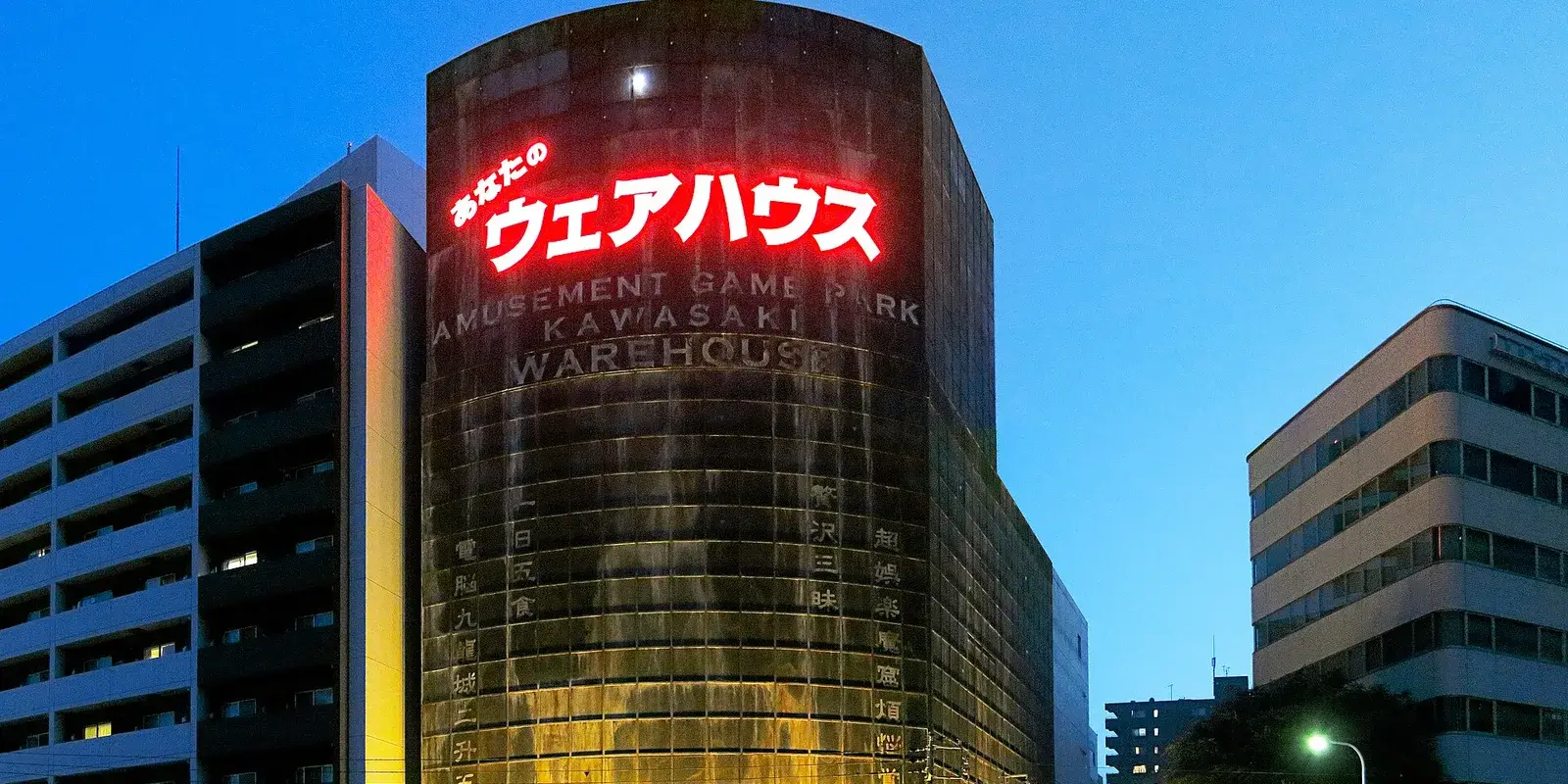
What Japanese People Actually Think When You Walk Into a Game Center: Claw Machines, Purikura, and Why Grown-Ups Play Too
What you'll learn in this article:
- What 543 Japanese people said about game centers across seven situations, from claw machines to purikura to paying
- Why the claw machine that "won't budge" is not a scam, and the one sentence that changes everything
- How purikura actually works (and why even Japanese people fumble the new machines)
- Why a salaryman in a suit, a grandmother, and a couple on a date are all there for the same reason: it's fun
Are Japanese game centers hard to figure out, and what's the etiquette? We read what 543 Japanese people wrote about seven arcade situations. The clear answer: almost nothing you fear is real. If the claw won't budge, players say staff will often reposition the prize, since it's part of the job. Adults play everywhere, and the only no-no is shaking the machine.
Quick Guide
| Situation | What Japanese People Said | |
|---|---|---|
| 🟢 Relax | The claw machine won't grab anything | Call the staff over: people who work the floor have written that repositioning the prize is part of the job. Asking how to win, even before you spend a yen, is completely normal. |
| 🟢 Relax | Spinning a gachapon as a grown adult | "Plenty of adults are spinning away, nobody's looking at you." The capsule-toy boom is largely driven by adults. |
| 🟢 Relax | Being a grown-up in an arcade at all | Suits after work, grandparents on the medal games, housewives at lunch, couples on dates. Japan's arcades are an all-ages room. |
| 🟡 Good to know | Purikura | There's a flow (shoot → doodle → print) with timers, and photos go to your phone by QR or app. Men-only groups are restricted at some shops, but couples and mixed groups are fine. |
| 🟡 Good to know | Paying | Mostly ¥100 coins and change machines, but major chains now let you tap a Suica or e-money card to play. |
| 🟡 Good to know | Whose turn is it? | Step back, read the room, and don't keep feeding coins into a busy machine while someone waits. Honestly? Getting it slightly wrong is fine. |
| 🔴 Worth noting | Shaking or yanking the claw machine; hogging a popular machine | The handful of behaviors that genuinely bother people are all physical: rocking the cabinet, or monopolizing a machine others are waiting for. |
The one thing to remember: A Japanese game center isn't a kids' place, and it isn't a test. It's where grown-ups go to play seriously. Mind the machine (don't shake it) and the person who might be waiting, and the room takes care of the rest.
How We Gathered These Voices
We collected 543 Japanese-language responses across seven game-center topics: the claw machine and asking staff for help (71 responses), how purikura works (86), who's actually allowed to use purikura (77), paying and change machines (79), gachapon culture (75), taking turns and sharing space (80), and who goes to arcades across the generations (75). Sources include public Japanese Q&A sites, forums, and social posts, alongside J-CAST News, Shueisha Online, Higo Journal, Minaminippon Shimbun, and other Japanese media, plus official information from operators like Taito, GiGO, and SEGA, and industry data from JAIA and Japan's capsule-toy and toy associations.
A quick note: This is a collection of what real Japanese people said in their own words, on public platforms, rather than a controlled scientific survey. Most arcade guides tell you which game center is "cheap and fun." We wanted to show you what the people next to you (the staff, the regulars, the salaryman quietly working a claw machine) actually feel.
The Claw Machine "Won't Move," And That's Not a Conspiracy
If you've ever fed coin after coin into a UFO catcher and watched the claw close on absolutely nothing, you've felt it: this thing is rigged. Here's the honest picture, straight from 71 voices, including several from people who say they work the arcade floor.
About a third were reassuring (staff are happy to help, asking is fine), about a third were "it depends," and about a third were frustrations. But here's the key: almost none of that frustration is aimed at you.
The single most useful thing we found: calling a staff member over is not begging, and it's not rude. It's the system working as intended. People who say they've worked the floor were blunt about it:
置き直しをはじめとする、お客様が景品を獲得されるまでの全てがお仕事です。 "Repositioning the prize, and everything else up to the moment you win it — that's all part of the job." (Arcade staff)
せっかくお金を使うのだから、最終的に景品は獲得してほしいな、という気持ちで接客しています。 "You're spending your money, so I genuinely want you to walk away with the prize. That's how I work the floor." (Arcade staff)
You can even ask before you spend anything. According to the voices, walking up and saying "I'm hopeless at this, how do I win?" gets you a real lesson, free of charge. And if you've already dumped coins in and the prize hasn't moved, telling staff "I've tried this a bunch of times and it won't budge" often prompts them to nudge it into a winnable position.
「何回くらいやったんだけど動かない」と言うと、店員さんの判断でアシストしてくれます。 "If you say 'I've gone quite a few rounds and it just won't move,' the staff will often give you an assist, at their discretion."
Why would a shop help you win? Because a customer who burns ¥4,000 and leaves empty-handed and annoyed is bad for business. There's also a quieter reason behind the "impossible" feeling: by law and industry guideline, the prizes are capped at a retail value of roughly ¥1,000 each (raised from about ¥800 back in 2022), so machines are tuned around a target spend rather than pure luck. The difficulty is a system, not a trick, and the same system gives staff the power to tip the balance back toward you.
So what does bother people? One thing, and it's physical:
機械自体を揺らすのは泥棒と同じです。 "Shaking the machine itself is the same as stealing."
That's the line. Rocking, lifting, or yanking the cabinet to jostle a prize loose is the one universally frowned-on move (and a fast way to get asked to leave). Spending a few hundred yen and walking away? Totally normal, nobody thinks twice. Even the slightly awkward feeling of having staff reset the prize again and again is one Japanese players know well:
位置変えたいときはお声がけください、と言われて何度も置き直してもらったけど、店員さんが謝るからなんか僕も申し訳なくて。 "They told me to just ask whenever I wanted the prize moved, so I had them reset it again and again — but the staff kept apologizing, which made me feel a little sorry too."
If you want a script for flagging down a staff member, a simple sumimasen and a point at the machine is all it takes.
The real rule: The claw machine isn't out to cheat you, and asking for help is the intended move, not a defeat. Call staff over, ask how to win, and never shake the cabinet. That's the whole game.
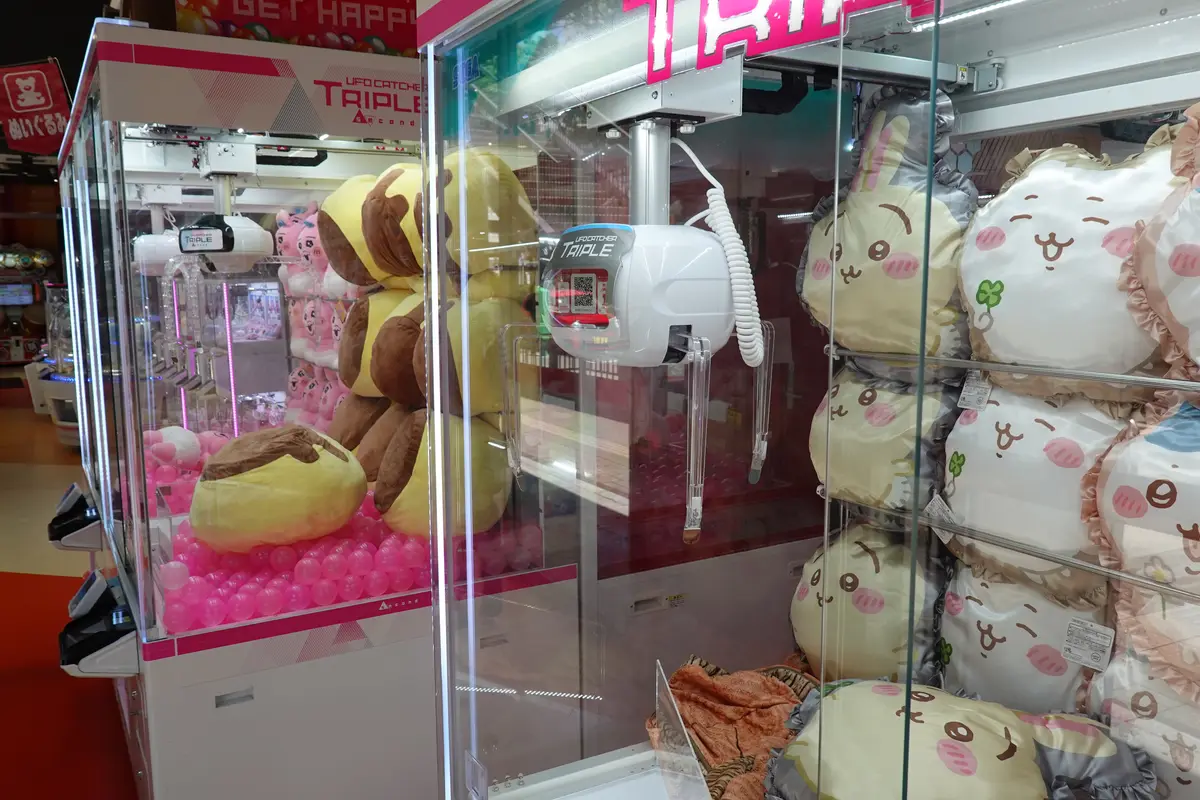
Purikura, Step by Step (Even Locals Fumble the New Ones)
Purikura (the photo-sticker booths) look intimidating from outside: flashing lights, a curtain, a machine barking instructions in rapid Japanese, and a timer counting down. Of 86 responses, most were simply practical ("here's the flow"), a solid third were positive ("it's genuinely easy"), and only one in ten were frustrations.
The flow is the same almost everywhere:
お金を入れる → 撮る → 落書きや加工をする → 出てくるのを待つ。 "Put your money in → take the photos → doodle and edit → wait for them to print."
And you are not expected to memorize it. The machine guides you the whole way:
プリ機によって少し違うけど、撮ってるとアナウンスが流れたり画面に表示されたりして、わかりやすく説明してくれるよ! "It's a little different by machine, but while you shoot, it plays announcements and shows on-screen prompts — it explains everything really clearly."
The one thing worth knowing in advance: each stage is timed, and the editing stage especially can feel fast. Even Japanese users get caught out by how quickly it moves:
どんどん撮られていくからびっくりした。 "It just keeps snapping one shot after another — it surprised me."
全部の順序に時間制限があるから、落書きするなら早めに仕上げた方がいいよ。 "Every stage has a time limit, so if you want to doodle, finish up early."
Getting your photos onto your phone is the last little puzzle, and it's simpler than it looks. At the major makers, there's a QR code on the machine or printed on your sticker sheet: scan it (or enter the sheet's ID) in the maker's free app, and the digital images come to your phone. SEGA machines use an app called Purikura ON; FuRyu, Japan's biggest purikura maker, uses one called PICTLINK. A free account usually gets you a couple of images; an all-photos download is a small paid plan. As one user put it:
プリクラの端っこにあるQRコードを読み取ってみたら?私もそれで保存してるよ! "Try scanning the QR code on the edge of the machine — that's how I save mine, too!"
The shortcut: Don't pre-study the buttons. Put in your money (users say it's usually ¥400–¥500), follow the on-screen prompts, work fast during the doodle stage, and scan the QR code at the end to get the photos on your phone. The machine is on your side.
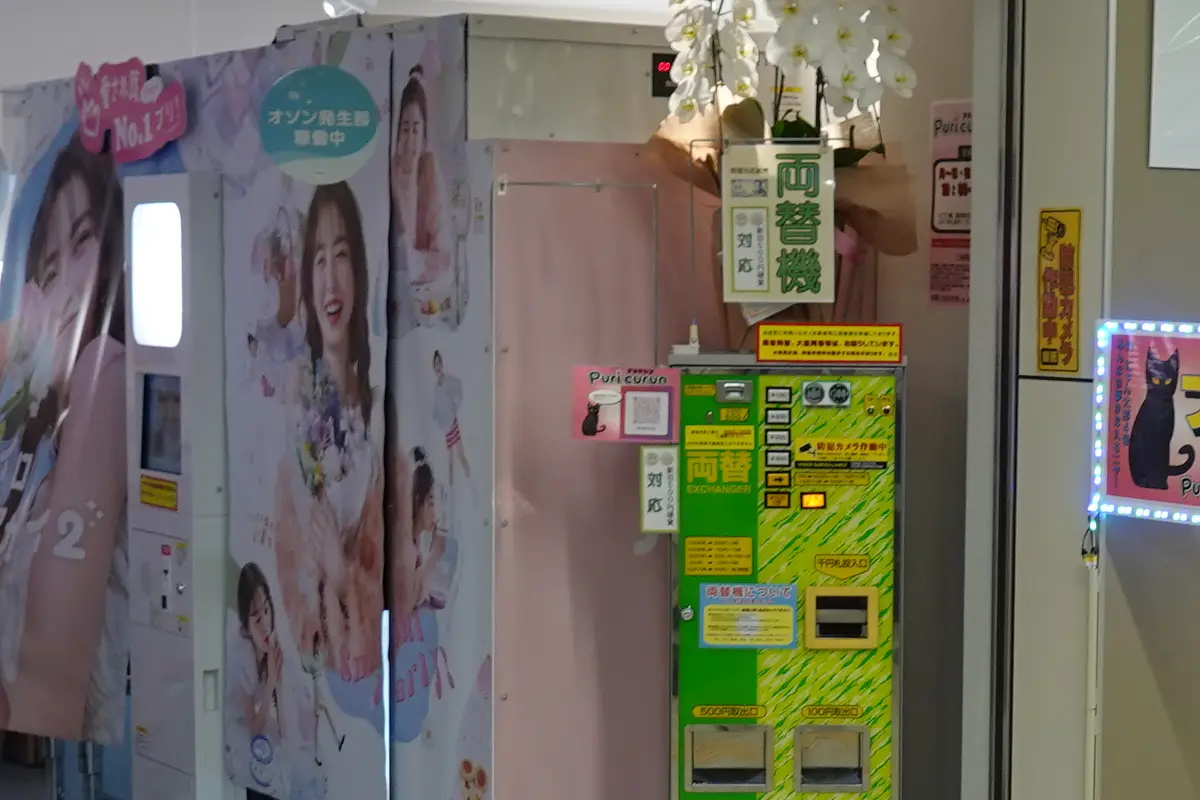
"Wait, Am I Even Allowed In?" Who Purikura Is For
Here's a worry that stops a lot of visitors at the curtain: Is purikura a girls-only thing? Can men go in? Can a foreigner? Can I go alone? You may have even seen a sign that looks like it bans men. Of 77 responses, the reassuring news comes through clearly, but it deserves a careful, honest explanation.
The single most clarifying voice we found reframes the whole thing:
「男だけプリクラ禁止」ではなく、「男だけでプリクラコーナーに入るのが禁止」ということ。 "It's not 'men are banned from purikura' — it's 'a group of only men can't enter the purikura corner.'"
In other words: there's no law, and it's never about you being a tourist. It's a shop-by-shop rule, and it targets exactly one configuration (men with no women in the group) at some venues.
そもそもプリクラに男性禁止なんて法律はありません。定めているのはその場所の管理人です。 "There's no law banning men from purikura in the first place. Whatever rule exists is set by that particular venue's management."
店舗によります。男女カップルや混合グループならOK、というところも多いです。 "It depends on the shop. Plenty of places are fine with male–female couples or mixed groups."
So a couple is fine. A mixed group of friends is fine. A solo person is usually fine. Why do some shops restrict men-only groups? Japanese media that looked into it traced the rule to a documented pattern: purikura corners had become targets for men hassling, photographing, or following the young women using them, so shops created the rule to keep that space feeling safe.
客層の殆どが女性だったので、女性が安心して気持ちよく過ごせる環境を作りましょう、ということです。 "Since almost all the customers were women, the idea was simply to make a space where women could feel safe and comfortable." (Higo Journal)
And to be fair to everyone, the friction is real and people say so openly: plenty of men find the rule genuinely disappointing:
仲間同士でノリで撮ったりするんで、男グループNGとかだと悲しい。 "My friends and I sometimes take purikura just for the fun of it, so a 'no all-male groups' rule is honestly a bit sad."
We're not here to settle whether the rule is fair, since Japanese people themselves don't fully agree on it. The practical takeaway for a visitor is simple and freeing: as a couple, a mixed group, a family, or a solo traveler, the curtain is open to you. If you happen to be a group of only guys and one shop says no, another down the street very likely says yes.
The real message: Purikura isn't gatekept against foreigners or against men in general. The only common restriction is on men-only groups at certain shops, for a safety reason. Couples, mixed groups, families, and solo visitors are welcome to step right in.
Money: Coins, Change Machines, and Tapping Your Suica
The most basic worry is often the most paralyzing: how do I even pay? You walk in with a ¥1,000 note and a wall of machines that seem to want ¥100 coins. Of 79 responses, the picture is reassuring once you know the two or three small things going on.
The traditional model is coins. Most games run on ¥100 coins, and there are change machines (両替機) dotted around the floor that turn your notes into coins. They're straightforward:
100円×10、×20、×30と選べて、あとは1000円札で返ってくる。 "You pick ¥100 × 10, × 20, or × 30, and any remainder comes back as ¥1,000 notes."
The honest friction shows up in the voices, and it's all small stuff: not wanting a pocket full of coins, worrying you'll accidentally turn a whole ¥10,000 note into a brick of change, or the faint awkwardness of using a change machine and then not playing.
100円玉を20枚も持つのも嫌だし、財布がパンパンになってしまう。 "I don't love carrying twenty ¥100 coins — my wallet ends up stuffed."
That last worry, "is it rude to only change money and leave?", has a simple answer in the voices: if you actually play a game there, no one minds at all.
そのゲームセンターのゲームをするのであれば、文句は言われないですよ。 "As long as you play a game at that arcade, nobody's going to complain."
And the good news for 2026: you increasingly don't need coins at all. Major chains have gone cashless. Taito Station lets you tap a transit IC card like Suica or PASMO (or other e-money) right on a reader at the machine instead of feeding coins, and it works on video games, music games, claw machines, and purikura alike. SEGA/GiGO rolled out e-money across many of its stores too, explicitly citing convenience for overseas visitors who already carry a transit card. One regular summed up why players welcomed it:
電子マネーが使えるゲームセンターは、店にも客にも双方にメリットがあると思う。 "An arcade where e-money works has real upsides for the shop and the customer alike."
If you want the bigger picture on when Japan still expects cash versus when a tap will do, our guide to paying with cash or card in Japan covers the whole landscape.
The bottom line: Bring some ¥100 coins or use the change machine, and if you're at a big-chain arcade in a city, just tap your Suica. Changing money and then playing is completely normal; nobody's watching your wallet.
Gachapon: Yes, Grown Adults Are Spinning Too
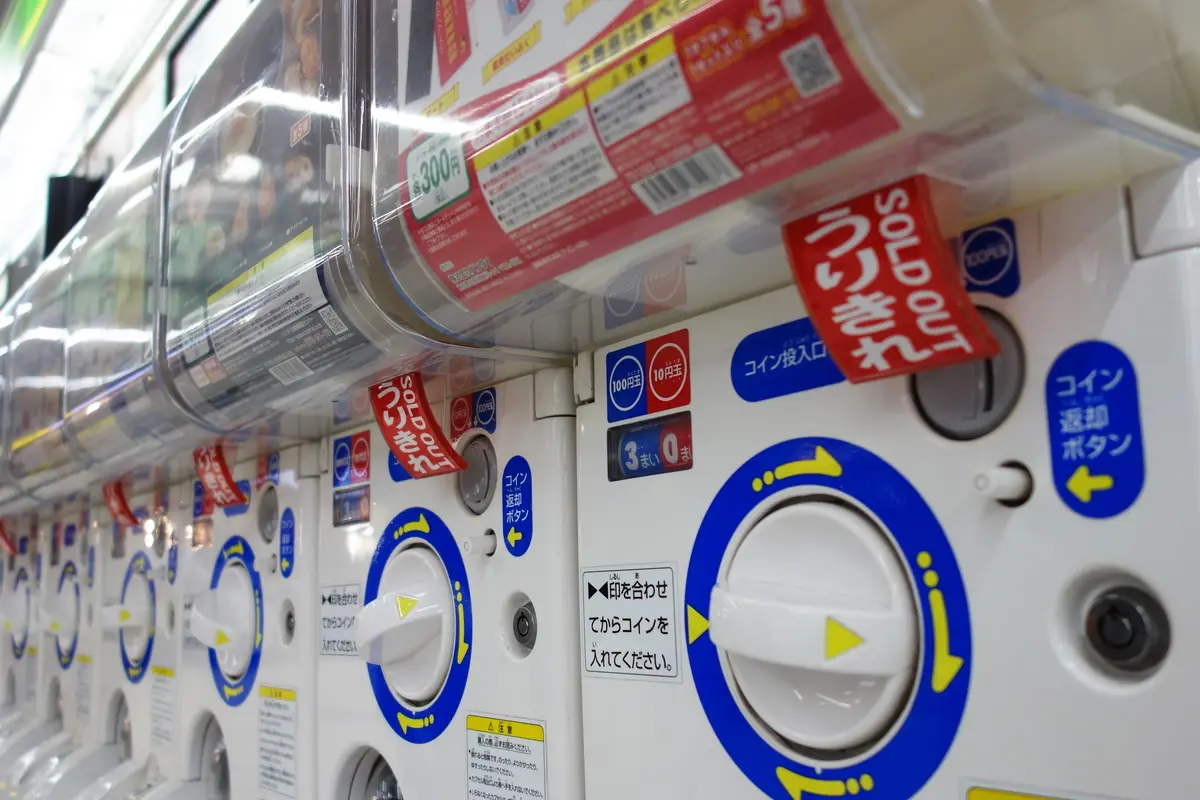
Those walls of capsule-toy machines, known as gachapon, are one of the most photographed things in Japan, and one of the most quietly intimidating to actually use. The big worry isn't mechanical; it's social: isn't it a bit embarrassing for an adult to crouch down and crank a toy machine? Of 75 responses, the answer is a warm, resounding no.
Some people did admit the shy feeling out loud, which is exactly why the reassurance lands so well:
一人でガチャを回すのなんか恥ずかしいんですが、みなさんどういう感じで行ってますか? "Spinning a gachapon by myself feels kind of embarrassing — how does everyone else handle it?"
And the answers came back, again and again, with the same easy shrug:
結構1人で黙々と回してる方たくさんいるので、気にしないでください! "There are loads of people quietly spinning away on their own — please don't worry about it!"
今時、大人もわんさかいるので、誰も人のことなんて見てないですよ! "These days there are tons of adults doing it — nobody's paying you the slightest attention."
This isn't just kindness; it's the truth of the market. Gachapon has roughly doubled in a decade and is now a genuine adult hobby. Japan's capsule-toy and toy associations describe buyers spanning "from small children to the elderly," and the boom is fueled by adults treating it as a small, affordable thrill. Whole specialty stores have sprung up, packed wall-to-wall with hundreds of machines. The appeal is the not-knowing:
「何が出るかわからない」ドキドキ感、たまりませんよね。 "That 'I have no idea what's coming out' rush of anticipation — it's irresistible."
There's one tiny piece of courtesy the voices describe. You'll usually find change machines right by the gachapon walls, and locals treat them as being there for people who are actually spinning, so if you only need to break a note, the kind move is to spin at least one capsule, or change your money where you're actually buying something. And a gentle warning the voices echo: chasing the one figure you want can quietly empty your wallet, one "just one more" at a time.
The real message: No adult is too old for gachapon. Half the people at the wall are grown-ups, and not one of them is judging you. Spin for the joy of the surprise, change your coins where you play, and know when to stop at "one more."
Whose Turn Is It? The Rule Nobody Can Quite Explain
This is the anxiety that hums under everything else in an arcade: there's no line, so how do I know whose turn it is? Can I leave my bag on a machine? What if someone's waiting? Of 80 responses, the overwhelming majority were practical, lived-in advice, with a clear minority pointing at the one behavior that frays tempers.
First, the reassurance, and it comes from someone who says they worked the floor:
この順番待ちは、ぶっちゃけ間違えても大丈夫。何が間違えなのか、みんな分かっていないんです。 "Honestly, you can get this turn-taking thing wrong and it's fine. Nobody really knows what 'wrong' even is." (Former arcade staff)
The practical norm most people described is gentle and intuitive: when you finish a round on a machine others might want, step back a few paces and check. If nobody comes for it in ten or fifteen seconds, carry on.
一台しかないなら一回離れて、10〜15秒見て誰もやる気配がなければ、もう一度やる。 "If there's only one machine, step away once; watch for ten or fifteen seconds, and if nobody moves to play, go again."
数歩下がって後ろで待つようにしましょう。 "Take a few steps back and wait behind, rather than right on top of the machine."
The one move that genuinely irritates regulars has a name: renko (連コイン): immediately feeding in another coin to keep playing a popular, single-copy machine while someone is clearly waiting. The voices about it are colorful, and they're all specifically about that situation rather than about playing a long time in general:
100円溶かしたら、とっとと交代するんが筋っちゅうもんじゃろがい! "Once you've burned your hundred yen, the decent thing is to hand it over and swap — that's just how it goes!"
Notice what this isn't about: it isn't about playing badly, playing alone for a long time on an empty floor, or being new. It's about reading whether a specific machine has someone waiting. On a quiet floor with empty machines all around, none of this applies, so play as long as you like.
And what about filming? A lot of visitors freeze up wondering if they can record their claw-machine victory or the dazzling purikura wall. Personal filming is generally fine: GiGO, a major operator, says on its official site that it puts no restriction on customers' own still or video photography. But it adds the key condition, and it's the same one that applies anywhere in Japan: don't post footage showing other customers or staff without their okay. Keep strangers (especially other people at the purikura booths) out of your frame and off your social feed. For the full picture, see our guides to photo etiquette at tourist spots and being filmed in Japan.
The one real rule: Watch the machine and the person who might be waiting for it. Step back, check, and don't renko a busy single-machine game. Everything else (how long you play, how badly, whether you film your own win) is yours to enjoy.
Who Goes to Arcades Now? (Hint: Everyone)
Here's the perception gap that surprises almost every visitor. Overseas, "arcade" often means a place for kids and teenagers. In Japan, walk into a game center on a weekday afternoon and you'll find something else entirely, and it's the heart of what makes these places special. Of 75 responses on who actually plays, the warmth was overwhelming.
The everyday reality, in one unfiltered voice:
平日は主婦も多いよー、平気平気。誰もお前のことなんか見てねーわ。 "There are loads of housewives on weekdays — you're totally fine. Nobody's looking at you."
An arcade floor staffer described how completely the crowd has shifted from the stereotype of die-hard gamers:
かつての主な顧客層は今や少数派で、カップルや家族連れのライト層がぐっと増えた。 "The old core customers are a minority now — couples and families, the casual crowd, have grown enormously."
Most moving were the older players. For many seniors, the arcade is part gym, part clubhouse: a place to keep the mind sharp and to not be alone:
我々高齢者は、放っておくと認知症になりかねない。ゲームは脳の活性化に役立つ。 "For us older folks, sitting idle can lead to dementia. Games help keep the brain active." (J-CAST News)
高齢のお客さま同士で積極的にコミュニケーションを取り、お友だちをたくさん作って常連になる。 "Elderly customers strike up conversations with each other, make lots of friends, and become regulars."
Across 543 voices, the same picture comes through: in Japan, playing (seriously, joyfully, at any age) is simply ordinary, and the arcade is one of the places that makes room for it. A salaryman in a suit working a claw machine after a long day is doing the most everyday thing in the world.
And if you do feel a flicker of "am I too old for this?", you're in good company. Some Japanese adults feel it too:
いい大人になったけど、まだゲームセンターにいるのが恥ずかしい。 "I'm a proper grown-up now, but I still feel a little embarrassed being in a game center."
The difference is, they go anyway, because the room has long since stopped caring. If karaoke is Japan's private room for letting loose with friends (more on that in what your Japanese friends really think at karaoke), the game center is its open-floor cousin: a place where a grandmother, a couple on a date, and a tired office worker can all be playing within ten feet of each other, and it's the most normal thing in the world.
What Japanese People Actually Want You to Know
After reading 543 Japanese voices about game centers, a few truths come through clearly:
The claw machine isn't a scam, and asking for help is the move. Call staff over and ask how to win, even before you spend: people who work the floor write that they'll often reposition the prize. The only thing that genuinely bothers people is shaking the machine.
Purikura is easier than it looks. Follow the on-screen prompts, move fast during the doodle stage, and scan the QR code to get your photos. Couples, mixed groups, families, and solo visitors are all welcome; the only common restriction is on men-only groups at some shops.
Paying is simple, and increasingly cashless. ¥100 coins and change machines are the classic way; at big-chain city arcades, just tap your Suica.
Gachapon is for grown-ups too. Half the wall is adults. Spin for the joy of it; nobody's judging.
Mind the machine and the person waiting. Step back and check before you keep playing a busy single machine. Get it slightly wrong and it's fine; even the staff say so.
It's an all-ages room. Suits, seniors, housewives, couples. Playing seriously as an adult is not just accepted in Japan; it's part of the culture.
The gap between what visitors worry about and what Japanese people actually care about is enormous. You're worried about looking like you don't belong. They're hoping you'll just relax, drop in a coin, and have fun.
A Practical Note: How a Japanese Game Center Works
For first-time visitors, here's the quick version:
- Floors by theme: Big arcades stack their genres: claw machines (UFO catchers) and purikura near the entrance to pull people in, music and video games higher up, and medal games and retro corners tucked away. Wander; there's no wrong floor.
- Paying: ¥100 coins are the classic currency, with change machines (両替機) on every floor. Major chains (Taito Station, GiGO, namco, Round1) increasingly let you tap a Suica/PASMO or e-money card right at the machine.
- Prizes: Claw-machine prizes are capped at roughly ¥1,000 retail value, so they're balanced around a target spend, and staff can and will help. Don't be shy.
- Purikura: Around ¥400–¥500 per session, by most accounts. Follow the prompts, work fast in the editing stage, and grab your photos via the QR code and the maker's free app.
- Where to find them: Akihabara, Shibuya, Ikebukuro, and Osaka's Den-Den Town are arcade-dense, but you'll find game centers near most major stations and in shopping malls nationwide. For getting to those neighborhoods, see getting around Japan.
If walking into an unfamiliar Japanese venue and not knowing the unwritten rules sounds familiar, you might also like your first izakaya: the "everyone was a beginner once" feeling is exactly the same.
Share Your Game Center Story
Have you played at a Japanese game center? Did a staff member quietly save your claw-machine dignity? Did you fumble your first purikura, or nail it? Did you spot a grandmother absolutely dominating the medal games?
We'd love to hear your story, and the stories of Japanese people reading this. Your experience helps the next visitor walk through that glowing entrance with a little more confidence.
Sources
Japanese Voices (543 responses across 7 topics)
arcade_claw_machine (71 responses):
- Public Japanese Q&A sites, forums, blogs, and social posts: first-hand opinions on calling staff, the "you can't win" feeling, and machine etiquette, including voices from people who say they have worked the arcade floor
- The ¥4,000 example in this section ("a customer who burns ¥4,000 and leaves empty-handed") comes directly from these voices, several of whom describe spending 4000 yen on a machine and winning nothing.
arcade_purikura_howto (86 responses):
- Public Japanese Q&A sites, kids' forums, and social posts: first-hand explanations of the purikura flow, timers, and saving photos to a phone
- The ¥400-¥500 purikura price range in this article is drawn directly from these voices (400 yen to 500 yen per session, by most accounts).
- SEGA (Purikura ON) and FuRyu (PICTLINK): official information on transferring purikura photos to smartphones
arcade_purikura_who (77 responses):
- Public Japanese Q&A sites, forums, and social posts: first-hand opinions on who may use purikura
- Shueisha Online, Higo Journal, Minaminippon Shimbun: reporting on purikura-corner rules and their background
arcade_payment_change (79 responses):
- Public Japanese Q&A sites, forums, and blogs: first-hand opinions on coins, change machines, and the awkwardness of changing money
- The ¥100 coin, ¥1,000 note, and ¥10,000 note examples in this section come directly from these voices' own descriptions of paying and making change (e.g. 100 yen coins, a 1000 yen note, and a 10000 yen note).
- Taito and SEGA/GiGO: official information on e-money and transit-IC payment at game centers
- As of 2026, Taito Station and SEGA/GiGO continue to expand cashless/e-money acceptance at their locations, per the official information below.
arcade_gachapon (75 responses):
- Public Japanese Q&A sites, forums, and blogs: first-hand opinions on spinning gachapon as an adult and change-machine courtesy
- Japan Capsule Toy Association / Japan Toy Association: market-size and customer-base data
arcade_turn_taking (80 responses):
- Public Japanese Q&A sites, forums, and blogs: first-hand opinions on taking turns, renko, bag placement, and filming, including voices from former arcade staff
- GiGO: official statement that it does not restrict customers' personal photography
arcade_generation (75 responses):
- Public Japanese Q&A sites, forums, and social posts: first-hand opinions on who goes to arcades across the generations
- J-CAST News and senior-focused Japanese media: reporting and interviews on senior and adult arcade-goers
Industry & Operator Sources (facts)
- JAIA (Japan Amusement Industry Association): amusement-industry market data and the crane-game prize-value guideline (prizes roughly ¥1000 retail value or less; raised from about ¥800 in 2022)
- National Police Agency 風営法 interpretive standard on crane-game prize value (2022 revision), as reported by Bengo4.com News
- Japan Capsule Toy Association / Japan Toy Association: gachapon market growth and customer base
Note on Quotations
Quotes from online platforms have been lightly edited for readability (fixing typos, formatting for clarity). The meaning and intent of each comment remain unchanged. Original sources are linked below.
WMJS is written in Japan, in English, with AI help. We check every page, but English is not our first language. If a sentence reads oddly, tell us. One sentence is enough.
Thank you. A person reads every note.
How well do you know Japan?
Based on 51,218+ real Japanese voices
Want to know more? Ask Japanese people
Have a follow-up question about this topic? We'll ask real Japanese people.
Voice Box →