
Is Ritsurin Garden Worth It? Japan Left It Off the Famous List, and the People Who Go Can't Understand Why
You start planning a trip to Japan, someone mentions Ritsurin, and you look it up. Almost at once you hit a strange fact. Ask which gardens are Japan's greatest and you will be handed the same three every time, Kenroku-en, Koraku-en, Kairaku-en, the Three Great Gardens. Ritsurin is not one of them. And it sits over on Shikoku, off the Tokyo to Kyoto line most first trips follow. So a small doubt forms: is a garden that did not make the famous list worth a detour to an island your itinerary was going to skip?
The short answer is that the people who actually make the trip resolve that doubt almost unanimously. In their reviews, the two things that give people pause beforehand, the missing famous list and the long detour, fall away once they are through the gate. The only caveat they keep raising, and it comes mostly from the locals, is to give the place enough time and to pick the right season.
Is it worth the detour? (in visitors' own words)
We collected what international travelers who have actually walked Ritsurin say when they weigh up whether it was worth it. Weighted by how strongly each opinion resonated with other readers, here is how they fell.
What stands out is where the doubt goes once people have been. Over and over, the reviewers reach for the very list Ritsurin is missing from, and then put the garden right back on it. One visitor who had seen two of the official three wrote that "having visited two of those three (Kanazawa and Okayama), I think this one is equal to those in beauty." Another, fresh from a November visit, said it "may not be officially listed among Japan's 'Three Great Gardens,' but... I'd argue it belongs in that conversation without hesitation." A traveler weighing which garden to cross to Shikoku for was blunter: "I found Ritsurin far superior to Korakuen." And one review folded the whole puzzle into a single sentence: "We can not understand why this is not rated as one of the best gardens in Japan."
The thin neutral band is mostly logistics, and it is worth reading closely, because it is the same note the locals sound. Most of these visitors simply found the garden bigger than they had planned for, with the odd remark about a closed teahouse. "Please make sure you allocate at least 0,5day here, as the garden is very big," one wrote. Another, on the paid boat: "The 30 minute boat ride on the lake gives you a different perspective... but I wouldn't say it's a must do. The garden is definitely a must visit." Only two visitors came away truly let down: one had been cut short by mosquitoes and an early closing, and one felt the garden's several paths ran too much alike.
How it looks to the people who live beside it
There is a second layer most guides skip: what Japanese visitors and locals say about the same garden, in their own reviews. Their register is warmer, and also more measured.
Set the two gauges side by side and a surprise appears: the more cautious audience is the Japanese one. 85% of the travelers from abroad came away sure it was worth the trip, while nearly a third of the Japanese reviewers write a gentle "it depends." Read what the "it depends" is about, though, and it has nothing to do with the garden's quality. What they weigh is the season, the hours, and the sheer size. "It was bigger than I expected, so I'd recommend it to people who have time to spare," one writes. Another maps out the fix: "the garden is large and it takes quite a while to see it all, so if you're short on time, go from the front gate and loop counter-clockwise around this pond." A visitor from Okayama, home of one of the official three, admits the rivalry gently: "Being from Okayama I'm on Team Korakuen, but I learned that Ritsurin is pretty good too."
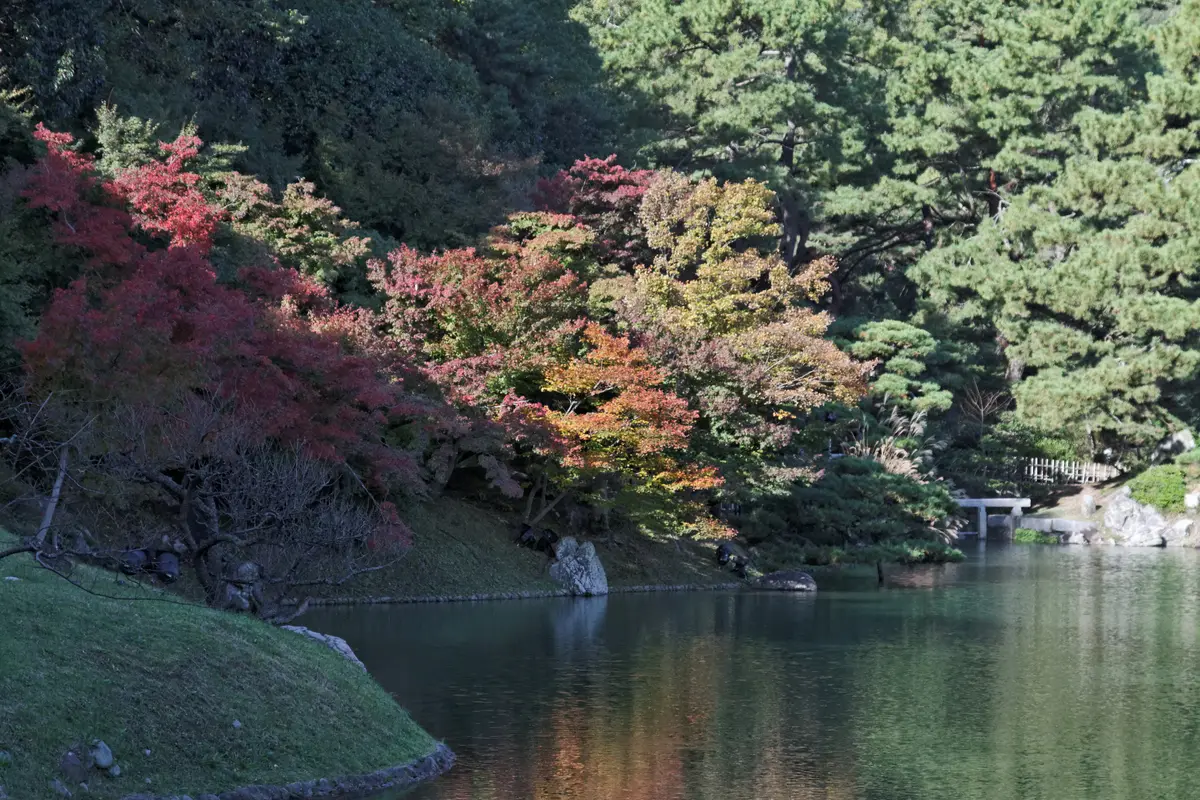
The one disappointed Japanese review proves the point rather than breaking it. "Because the season was in-between, there was nothing in bloom, and the park was one solid green of pines," one visitor wrote, having arrived at the wrong week. Even that let-down came down to timing. When the people who could visit any weekend tell you the whole secret is when you come and how long you stay, it is worth listening. They already take the garden's quality for granted. What they pass along is how to catch it at its best.
What we wish you'd noticed
Why the list skips it, and what Japan granted it instead. The Three Great Gardens were settled a little over a century ago: three lords' gardens, in three far-apart regions of the main island. Ritsurin, off on a smaller island, simply was not in the room when the list was drawn. What Japan formally granted it is a matter of record. It holds the country's highest rank for a garden, a Special Place of Scenic Beauty, raised to that top tier in 1953. Two of the famous three carry that same rank; the third, Kairaku-en, does not. Ritsurin is also the largest cultural-property garden in the entire country, about 75 hectares. And the Michelin Green Guide gave it three stars, the mark it reserves for a place "worth a special journey."
Part of why the list skips it is that it will not sit still for a single photograph. Each of the famous three has a signature view, one image the whole place folds down to, which is exactly what lets you rank them. Ritsurin was built around a different idea, three words the keepers still use: ippo ikkei, one step, one view. Take a step and the scene quietly rearranges. A hill hides what a bridge just revealed. You walk into Ritsurin more than you stand and photograph it, and a garden designed to keep changing as you move is hard to reduce to the one ranked image a list wants. A Japanese reviewer put it without the theory: the garden was "true to the phrase in the pamphlet, ippo ikkei."
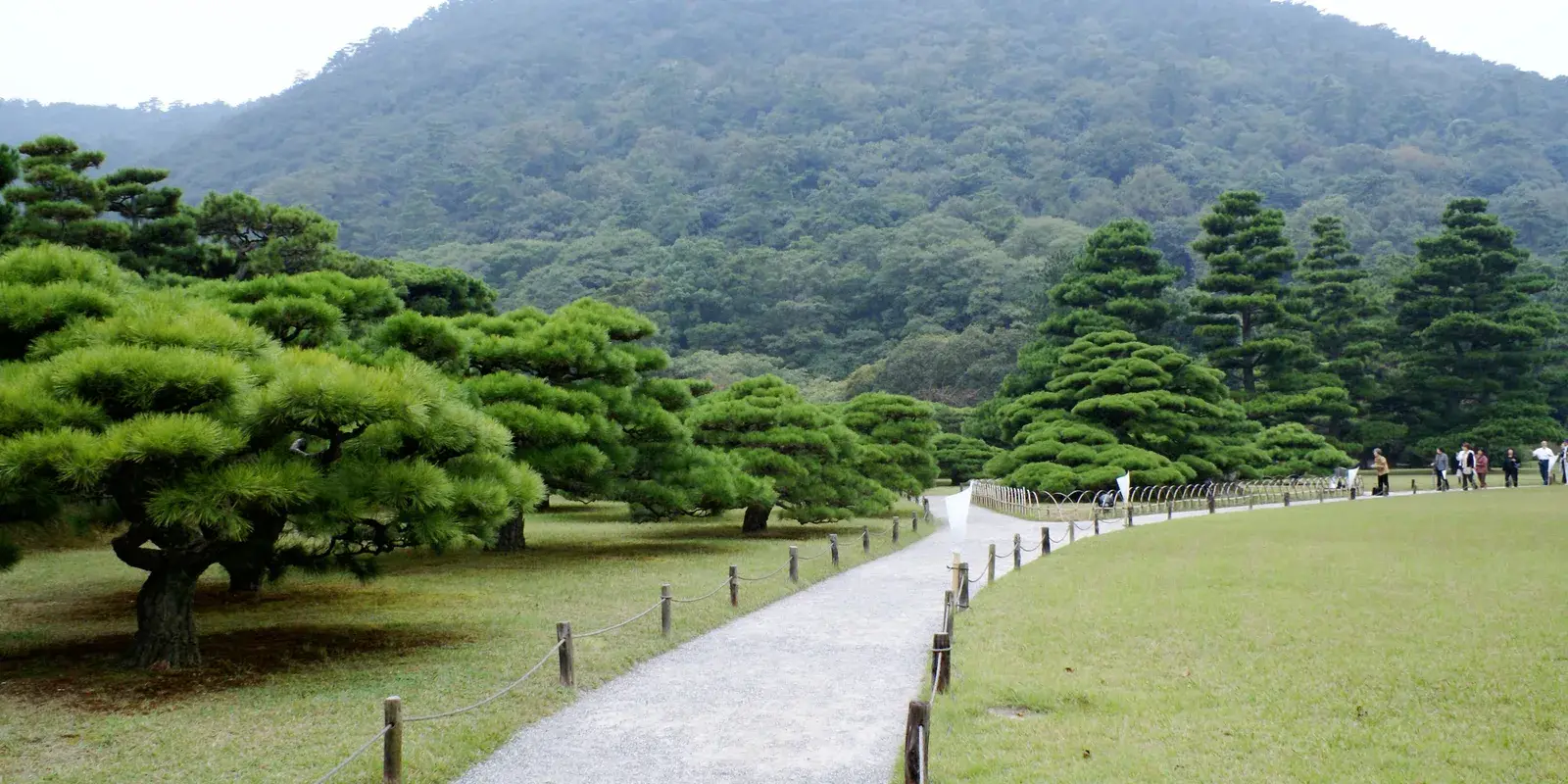
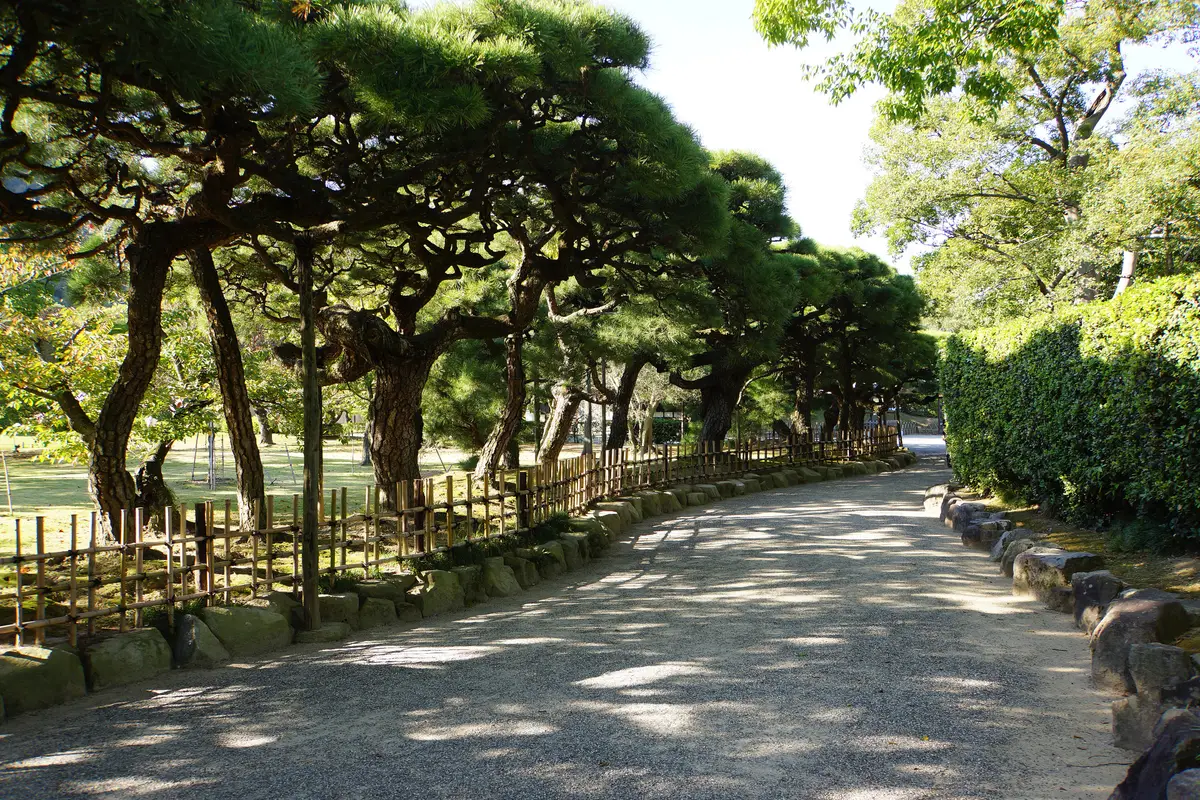
Almost everything you are looking at is being made by hand, today. There are about 1,400 pines in the garden, and roughly 1,000 of them are shaped entirely by hand, pruned tree by tree by gardeners who have passed the work down for some three centuries. Behind the signature view rises Mt. Shiun, a mountain the garden does not own but was composed to borrow, so completely that you cannot find the seam where the made garden ends and the wild slope begins. The whole thing was finished in 1745, after more than a hundred years of work, and the pruning has never once stopped since.
Doing it well, the welcomed way
Everything above resolves into a handful of moves the garden quietly rewards.
- Get off at the right station. This is the single most common way a visit starts badly. A JR station is named, very reasonably, "Ritsurin," and it leaves you a good twenty-minute walk away on unmarked streets. The two you actually want are the next ones over: Ritsurin-kōen on the local Kotoden line (about ten minutes from the East Gate) or Ritsurin-kōen-Kitaguchi on the JR line (barely three minutes from the North Gate).
- Come at opening, and give it the morning. Ritsurin opens around sunrise, as early as 5:30 in midsummer and about 7:00 in winter, and for the first hour it is nearly empty, with mist still lifting off the ponds. Both the enthusiasts and the "it depends" reviewers agree the place is large, so budget two to three hours.
- If you are short on time, walk the South Garden. The older, southern half holds the scenery Ritsurin is famous for. Climb the small hill called Hirai-hō, shaped to suggest Mt. Fuji, for the view that folds the arched bridge, the teahouse, and the borrowed mountain into one frame.
- Stop once, on purpose. Many visitors run out of time and wish they had paused. A bowl of matcha at the Kikugetsu-tei teahouse over the South Pond is ¥800; the flat wasen boat that loops the pond in about thirty minutes is ¥850, seats only six, and is worth booking ahead.
- Pick your season. The reviewers who felt shortchanged had usually come at an in-between week. Autumn foliage (with about ten nights of evening illumination) and spring are the prized windows, and a clear early morning in any season rarely disappoints.
- Then let the afternoon go to the sea. Most travelers know Takamatsu only as the port where you change for a ferry, and its harbor is the gateway to the art islands of the Seto Inland Sea. Give the garden the still first hours, and let the islands have the afternoon.
So, is it worth it? A garden the famous list forgot, on an island most trips skip, and yet the visitors who go call it the standout while the people who live beside it return to it for a lifetime. Most of them arrive in the first quiet hour and give it two or three unhurried hours. That, more than anything, is what the reviews keep pointing back to: an early start, a little patience, and a garden that quietly rearranges itself around you as you walk.
Weighing which big-name places truly deserve a slot on a short itinerary? What actually matters in Japan is a good place to start. And for the deeper story of the garden left off the famous three, the walk, the pines, and the borrowed mountain, the Ritsurin Garden audio guide sits just below.
Sources
- Kagawa Prefecture Tourism Association (Udon-ken Tabi-net), Ritsurin Garden, "Special". Completed over more than 100 years and finished in 1745; the largest Cultural Property Garden in Japan; about 75 hectares; six ponds and thirteen landscaped hills; about 1,400 pines, of which roughly 1,000 are kept hand-pruned; the Michelin Green Guide Japan three-star ("worth a special journey") rating; ippo ikkei, "one step, one view."
- Kagawa Prefecture Tourism Association, Ritsurin Garden, "Viewing / Highlights". Hirai-hō, a hill shaped to resemble Mt. Fuji and the garden's finest viewpoint; the Kikugetsu-tei teahouse on the South Pond; Mt. Shiun as the borrowed backdrop; the wasen boat ride.
- Ritsurin Garden, Official Visitor Information (garden operator). Open every day of the year; opening hours that shift by month roughly from sunrise to sunset; admission ¥500 for adults and ¥170 for children; the East and North gates; the wasen boat seats six, and reservations (accepted by phone or online from the first of the previous month) mean it is worth booking ahead.
- Ritsurin Garden, Official Notice of Fee Revision, June 1 2025. The current admission, wasen boat (¥850 adult / ¥420 child) and Kikugetsu-tei tea (matcha ¥800) prices in effect after the 2025 revision.
- Agency for Cultural Affairs, National Cultural Properties Database, Ritsurin-kōen. Designation as a Place of Scenic Beauty in 1922 and elevation to Special Place of Scenic Beauty on March 31 1953, under the criterion for parks and gardens.
- JNTO (Japan National Tourism Organization), Autumn Beauty: Ritsurin Garden. A "strolling-style daimyo garden" that took over 100 years to create and was completed in 1745; ippo ikkei as "every step, a different scene"; the autumn-colour illumination of roughly ten nights.
- Takamatsu City Tourism (art-takamatsu.com), Access via the Marine Liner. Takamatsu as the gateway to the Seto Inland Sea art islands, reached from Okayama across the Great Seto Bridge.
WMJS is written in Japan, in English, with AI help. We check every page, but English is not our first language. If a sentence reads oddly, tell us. One sentence is enough.
Thank you. A person reads every note.
How well do you know Japan?
Based on 51,218+ real Japanese voices
Want to know more? Ask Japanese people
Have a follow-up question about this topic? We'll ask real Japanese people.
Voice Box →